
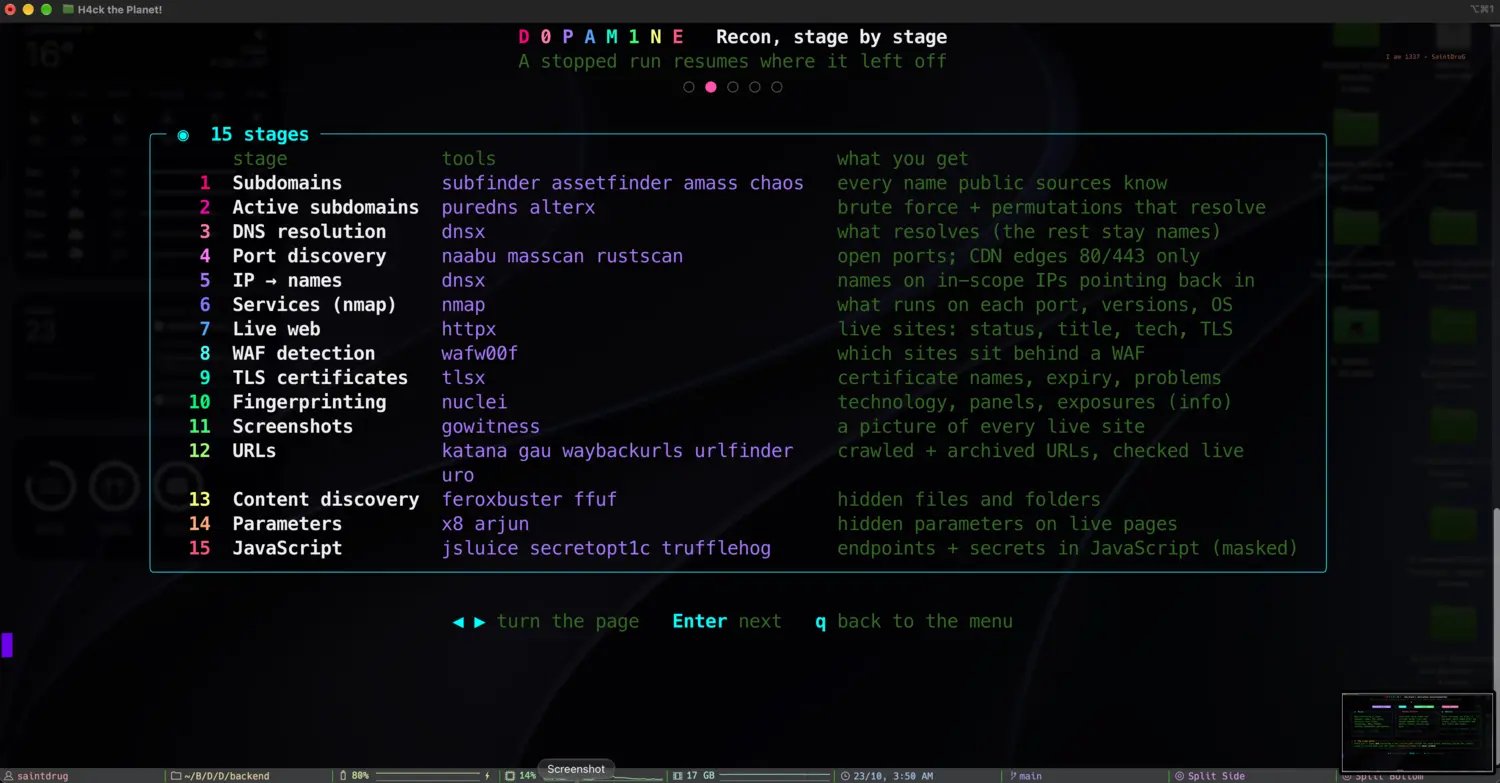
The fifteen stages, the tools each one runs, and what you get from it
--only and --skip:
The stages, in order
1. Subdomains
1. Subdomains
Passive subdomain enumeration from your in-scope bases: subfinder, assetfinder, amass (passive, with ASN and IP intel) and the Chaos dataset (needs an API key), plus crt.sh certificate transparency. IP-only scopes skip this (names come from PTR and certificates instead).
2. Active subdomains
2. Active subdomains
DNS brute force and permutations. puredns (with the massdns backend and public resolvers) resolves
word.base candidates with wildcard filtering; alterx generates permutations from the top DNS labels. Candidates under excluded names are never resolved.3. DNS resolution
3. DNS resolution
dnsx resolves A, AAAA and CNAME records with responses, at the profile’s DNS rate. Writes
dns.json and the list of names that did not resolve.4. Port discovery
4. Port discovery
naabu finds open ports (top 100, top 1000 or all 65535 by profile, CDN and excluded IPs removed). Large in-scope CIDR ranges are swept by masscan or rustscan. Path-limited hosts are not port scanned.
5. IP to names (pivot)
5. IP to names (pivot)
Reverse DNS (PTR) on in-scope IPs via dnsx. A discovered name is followed only when every address it resolves to is an in-scope IP.
6. Services (nmap)
6. Services (nmap)
nmap service, version and (where privileged) OS detection on the open ports, with your project’s nmap options and timing. Falls back to naabu’s open ports if nmap yields nothing.
7. Live web
7. Live web
httpx probes names and host:port pairs for live web: status, title, server, tech, IP, CDN, TLS and redirects. Writes
web.json, live.txt and passive HTTP records (headers and a bounded body).8. WAF detection
8. WAF detection
wafw00f fingerprints web application firewalls in front of the live hosts.
9. TLS certificates
9. TLS certificates
tlsx pulls certificate names and (optionally) TLS checks and versions. New in-scope certificate names are resolved and probed; names on in-scope IPs are followed.
10. Fingerprinting
10. Fingerprinting
nuclei runs only safe detection templates (technology, SSL and DNS, plus exposed panels on request) at info severity. No CVE or DAST templates run during recon, that is the attack phase.
11. Screenshots
11. Screenshots
gowitness screenshots every live web target (needs Chrome or Chromium).
12. URLs
12. URLs
Crawling and archives: katana (with optional JavaScript crawling), gau, waybackurls and urlfinder, deduplicated with uro. Every URL is then probed live with httpx. Writes
urls.txt, parameters and JavaScript file lists.13. Content discovery
13. Content discovery
feroxbuster (preferred) or ffuf brute-forces directories and files per site, with the profile’s wordlist, depth and time budget. Excluded paths are never requested.
14. Parameters
14. Parameters
x8 (preferred) or arjun discovers hidden query and body parameters using the SecLists
burp-parameter-names list.15. JavaScript
15. JavaScript
Fetches in-scope JavaScript (5 MB cap, no out-of-scope redirects) and analyses it with jsluice, SecretOpt1c and trufflehog for endpoints and secrets. Secrets are masked and never validated against the provider.
Control during a run
Pause and resume
d0pam1ne pause winds the tools running now down cleanly; d0pam1ne recon --resume continues the unfinished run from where it stopped.Stop one tool
d0pam1ne stop-tool <id> stops a single tool (or all) in a running recon; the run carries on with what the rest found.